 Sunday, September 27, 2026 · Serving all of Hudson County since March 2011
Netanyahu’s UN pager prop raises a harder question: could he use it against new enemies?
UNITED NATIONS — At the U.N. General Assembly on Sept. 24, 2026, Israeli Prime Minister Benjamin Netanyahu held up a pager at the podium and pointed the hall back to…
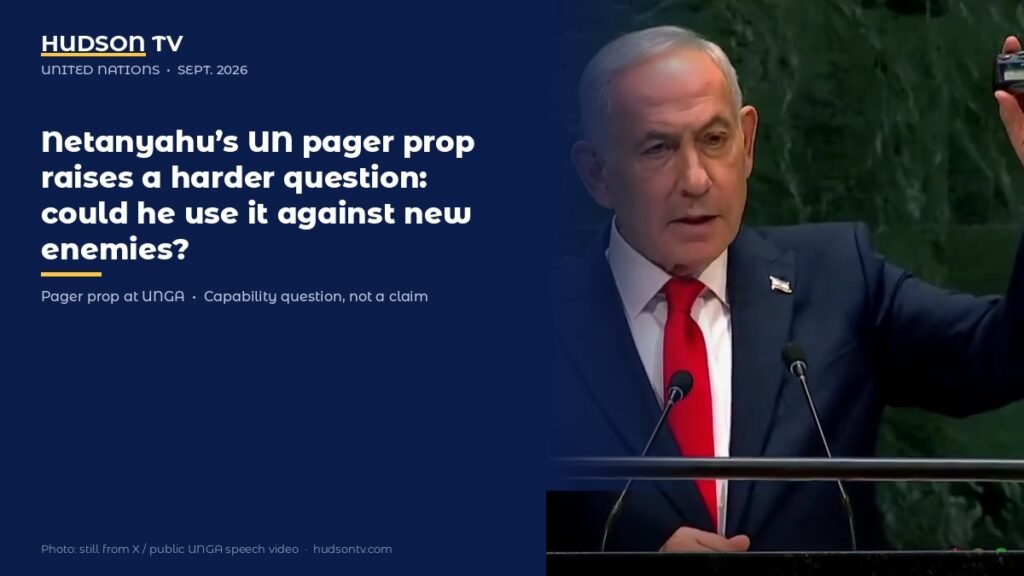
UNITED NATIONS — At the U.N. General Assembly on Sept. 24, 2026, Israeli Prime Minister Benjamin Netanyahu held up a pager at the podium and pointed the hall back to the September 2024 operation that wrecked much of Hezbollah’s pager-and-radio communications network.
The prop was brief. The question it leaves is not.
In the published text of the speech, Netanyahu ties the device to Israel’s campaign against Hezbollah after listing a “seven-front war.” The pager lines land as:
“You remember the beepers? Remember these things? Well, I can tell you this: Hezbollah certainly remembers them.”
Reporting and video of the same moment circulate close variants — “Remember the beepers?” and “Hezbollah certainly remembers them” — as he displays the black pager between his fingers. Some social posts compressed the bit into vernacular like “we paged Hezbollah”; that phrasing is paraphrase, not the published speech text.
Watch the UNGA pager moment (clip circulating on X):
— Health Ranger (@HealthRanger) September 25, 2026
He then claimed Hezbollah’s large rocket arsenal was largely gone and its leadership broken — claims that are part of his speech record, not independently re-litigated here.
Why show the capability?
The 2024 pager blasts were widely reported as a supply-chain compromise: devices destined for Hezbollah’s network that detonated when triggered, killing and wounding people across Lebanon and parts of Syria. Hezbollah blamed Israel; Israel later acknowledged its role. Netanyahu’s UNGA gesture did not add a new technical confession. It put the method on stage in New York.
That is why the harder question is not nostalgia. If a supply-chain method worked once against an adversary’s communications gear, the same class of method could, in theory, be aimed at old enemies or new ones — other militant networks, other states’ proxies, or any target that depends on trusted hardware shipped through opaque vendors. That is a capability question. It is not a claim that consumer phones are already bombs, and Netanyahu did not say that at the podium.
Online reaction after the speech pushed the “who else?” frame further. One circulating post framed the pager moment as a broader threat signal (@HealthRanger, embedded above). Separately, another post claimed members of Netanyahu’s delegation were listing diplomats who walked out of the hall during the address (@IsabellaM2050):
— Isabella (@IsabellaM2050) September 25, 2026
Those are social-media claims and interpretations, not verified evidence of a new targeting plan. What they do show is how quickly viewers connected a public prop about a past supply-chain strike to questions of signaling, memory, and who might be next in anyone’s ledger.
Walkouts at the start of the speech were widely reported; Netanyahu himself invited remaining “moral cowards” to leave. Whether anyone in the Israeli party was systematically noting names is unconfirmed here. The attributable point for this draft is simpler: the pager was shown on purpose, in a room full of governments, while the internet immediately asked who the reminder was for.
Bottom line: Netanyahu held a pager at UNGA, reminded the world that Hezbollah “certainly remembers” the beepers, and left a strategic question hanging in plain sight: why stage that capability in front of every capital that stayed in the hall — and every one that walked out? The answer may be deterrence theater aimed at Hezbollah alone. Or it may be a wider reminder that supply-chain warfare is a tool, not a one-off punchline. Hudson TV is asking the question. We are not filling in an answer he did not give.
0 comments
Sign in to comment