 Sunday, September 27, 2026 · Serving all of Hudson County since March 2011
Flock Safety demands removal of public map of its surveillance devices nationwide
Flock Safety — the Atlanta-based company behind one of the country’s largest automated license plate reader networks — has issued a legal demand seeking the removal of a newly published…
Flock Safety — the Atlanta-based company behind one of the country’s largest automated license plate reader networks — has issued a legal demand seeking the removal of a newly published public map that plots the locations of roughly 300,000 of its surveillance-related devices across the United States, according to a post circulating widely on X and corroborated by independent reporting.
Flock Safety has issued a legal demand seeking the removal of a public map showing the locations of approximately 300,000 of its surveillance devices across the United States.
— Leading Report (@LeadingReport) September 25, 2026
Reporting that cites The Intercept identifies the map as the work of cybersecurity researcher Joshua Michael. His “Flock Surveillance Map” is described as drawing on a December 2025 snapshot of Flock-related location records that Michael said he obtained after finding an unauthenticated access token that allowed queries to an ArcGIS mapping layer used in connection with Flock devices. Michael has said he notified the company in November 2025; Flock later indicated it was triaging the findings. Coverage says the exposed access was addressed after Michael published technical findings in early 2026.
Independent write-ups of that reporting put the map’s inventory well above Flock’s publicly cited camera count of more than 120,000 units: more than 170,000 cameras plus on the order of 130,000 accompanying devices (networking gear, third-party integrations, and tens of thousands of acoustic sensors), for a combined figure of roughly 300,000 — Tom’s Hardware, summarizing the same reporting, cites a list of 335,701 cameras on the site.
On Thursday, according to those accounts, Doppel — describing itself as acting on Flock’s behalf — sent a trademark infringement complaint alleging unauthorized use of the “FLOCK SAFETY” mark and requesting that the map site be taken down. Michael’s site carried a disclaimer of non-affiliation. Flock did not immediately respond to at least one outlet’s request for comment, according to that coverage. This article does not reproduce any map coordinates or residential addresses.
The privacy irony — commentary grounded in the record. The demand lands as Flock’s ALPR and related street hardware face sustained public discomfort over privacy: searchable vehicle-movement databases, documented misuse cases in national reporting, and bipartisan scrutiny in Congress. A Senate Judiciary subcommittee hearing on Sept. 23, 2026 — titled around Flock’s nationwide AI surveillance network — invited Flock’s CEO, among other industry chiefs; coverage says they declined to appear. Against that backdrop, a company whose cameras make many people uneasy about being tracked is now seeking to scrub a public inventory of where those devices sit. That contrast is the story’s irony — not a claim that any executive “opposes privacy” in words he never said, but a factual tension between selling pervasive roadside monitoring and trying to keep the network’s footprint harder for the public to see.
Hudson County context. Locally, automated license plate readers and related vendor systems are already part of the public debate. Hudson TV previously mapped documented county and municipal records — including a spring 2026 Weehawken county-pole ALPR item that did not advance after residents raised privacy and ICE concerns and Mayor Richard Turner asked the Board to pull it, and a June 2026 county authorization path for Hoboken ALPR and live-view gear on certain county traffic poles — alongside volunteer pin maps that remain incomplete and unofficial. See: Hudson County ALPR: capability vs. what officials say.
Flock and its customers argue the technology helps find stolen cars and solve crimes. Privacy advocates and some lawmakers argue nationwide plate-scan networks enable warrantless tracking and misuse. Michael’s map, and Flock’s trademark push to take it offline, sharpen a simpler fight over transparency: who gets to know where the cameras are.
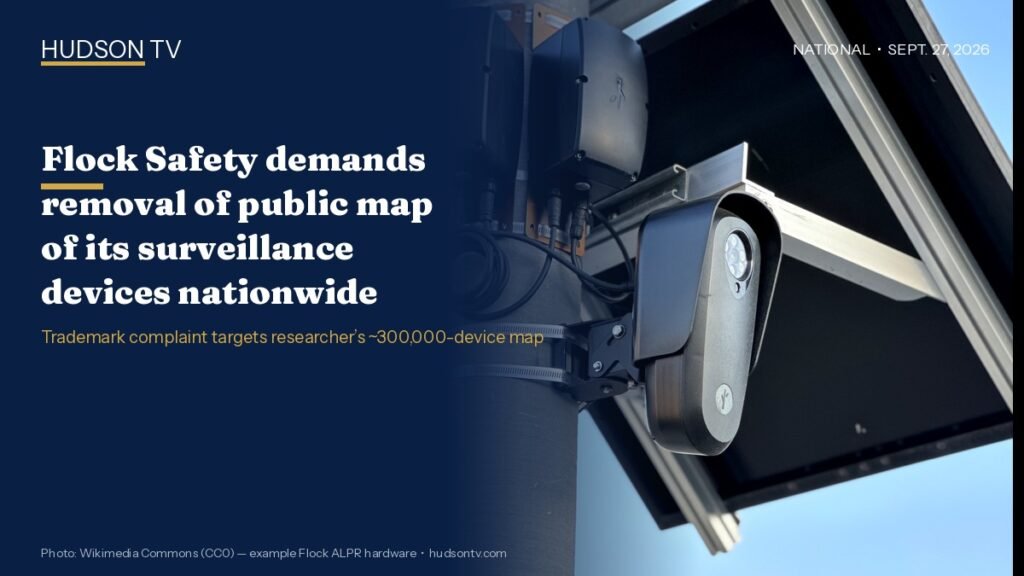
Photo credit (featured): Wikimedia Commons, public domain (CC0) — example Flock Safety ALPR hardware; not a Hudson County inventory photo. Sources: X post by @LeadingReport (Sept. 25, 2026); Tom’s Hardware / Intercept-cited reporting on Joshua Michael’s Flock Surveillance Map and Doppel trademark complaint; prior Hudson TV ALPR coverage.
0 comments
Sign in to comment