 Thursday, October 1, 2026 · Serving all of Hudson County since March 2011
Canal Crossing twin PILOTs: FA sets Stage One ASC at 10% of gross revenue for 15 years
JERSEY CITY — The Financial Agreements attached to Jersey City Ordinances 26-045 and 26-046 are now the attributable paper trail for Canal Crossing Phase 1 on Garfield Avenue: twin 30-year…
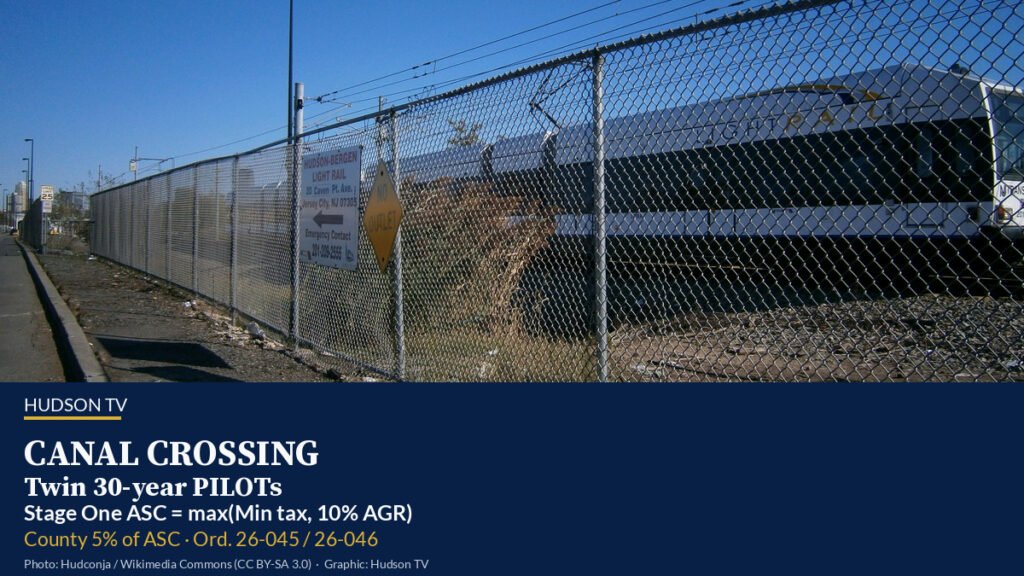
JERSEY CITY — The Financial Agreements attached to Jersey City Ordinances 26-045 and 26-046 are now the attributable paper trail for Canal Crossing Phase 1 on Garfield Avenue: twin 30-year Annual Service Charge schedules, staged from 10% of Annual Gross Revenue, with Hudson County limited to 5% of ASC under state law.
The Municipal Council gave second-and-final passage on Wednesday, Sep. 23, 2026. Mayor James Solomon approved both ordinances on Sep. 24, 2026, per the civicweb ordinance records. First reading was Jun. 10, 2026 (9–0 on both). Final roll calls diverge: Ord. 26-045 (Phase 1A) finished 9–0; Ord. 26-046 (Phase 1B) finished 7–0–2, with Councilman Frank Gilmore and Council President Denise Ridley recorded as abstaining on the Phase 1B sheet.
Hudson TV previously covered the Sep. 23 hearing’s public comment and vote drama. This package is the FA math — not a rehash of that night’s podium fight.
Photo: Hudconja / Wikimedia Commons (CC BY-SA 3.0). Graphic: Hudson TV.
Phase 1A — Ord. 26-045 / Garfield Phase 1A Urban Renewal LLC
Parcel: Block 21501.01, Lot 1 — 850–870 Garfield Avenue.
Building (FA recitals): new six-story mixed-use; 215 residential rental units, including 43 affordable units at or below 50% AMI; about 6,818 square feet of ground-floor retail; 68 parking spaces; designated bicycle parking and amenity package.
Cost / jobs (FA findings): total project cost estimated in excess of $141 million; annual operating expenses projected at about $2 million; about 275 temporary construction jobs and 30 permanent jobs.
Entity notices: c/o Boraie Development LLC, New Brunswick. Redeveloper designation under the 2018 Amended and Restated Redevelopment Agreement also names Hampshire Urban Renewal Redevelopment, LLC, Garfield JC Partners, LLC, and Phase 1B.
Phase 1B — Ord. 26-046 / Garfield Phase 1B Urban Renewal LLC
Parcel: Block 21501.02, Lot 1.01 — 874–902 Garfield Avenue.
Building (FA recitals): new ten-story mixed-use; 293 residential rental units, including 59 affordable units at or below 50% AMI; about 11,462 square feet of ground-floor retail; 212 parking spaces; designated bicycle parking and amenity package.
Cost / jobs (FA findings): total project cost estimated in excess of $176 million; annual operating expenses projected at about $3 million; about 350 temporary construction jobs and 50 permanent jobs.
Combined arithmetic from the two FAs: 508 rental units / 102 affordable — not a separate marketing total invented outside the ordinances.
Both agreements say the projects help deliver Park 12P (plaza ~33,000 sq ft) and a portion of the Morris Canal Greenway, and that operations run under the city’s PECA (Ord. 18-151) and living-wage code §3-76.
The ASC schedule (§4.04) — identical twin rungs
Both FAs use the same staged Annual Service Charge. ASC is due each Feb. 1, May 1, Aug. 1, and Nov. 1 after the Annual Service Charge Start Date, for up to 30 years from that start date (agreement term is 35 years from execution, subject to earlier termination).
| Stage | Years from ASC Start | ASC = greater of… |
|---|---|---|
| One | 1–15 | Minimum ASC or 10% of Annual Gross Revenue |
| Two | 16–18 | Minimum ASC; 11% AGR; or 20% of conventional taxes otherwise due on Improvements + Land |
| Three | 19–21 | Minimum ASC; 11% AGR; or 40% of conventional taxes |
| Four | 22–24 | Minimum ASC; 11% AGR; or 60% of conventional taxes |
| Five (yr 25) | 25 | Minimum ASC; 11% AGR; or 80% of conventional taxes |
| Five (yrs 26–30) | 26–30 | Minimum ASC; 12% AGR; or 80% of conventional taxes |
Minimum Annual Service Charge (both FAs): the total taxes levied against that phase’s parcel in the last full tax year it was subject to conventional taxation. The FAs do not state a dollar Minimum ASC — Hudson TV will not invent one.
Admin fee (§4.09): Entity pays the city 2% of that year’s ASC by Nov. 1 (N.J.S.A. 40A:20-9).
County share (§4.08): City remits 5% of ASC received to Hudson County pursuant to N.J.S.A. 40A:20-12. That is a cut of the PILOT — not a conventional ad-valorem school or county tax line on improvements while the exemption runs.
Land taxes: Land Tax Payments continue until the ASC Start Date. From the ASC Start Date through expiration/termination, the parcel is exempt from Land Taxes under N.J.S.A. 40A:20-12 (FA §4.05). Improvements and Land are tax-exempt as provided in the FA for the exemption term.
What is not in these FAs: Neither financial agreement dedicates a percentage of ASC to the Jersey City Board of Education or a schools capital account. Any citywide “PILOT-to-schools” proposal belongs to separate policy paper — including the administration’s own June 16, 2026 Interim Budget Report language about directing 10% of PILOT revenue to public schools — not to the Ord. 26-045 / 26-046 contract text Hudson TV reviewed. Do not treat that proposal as a clause in these twins.
Tax-crisis contrast — audit vs. new deals (timeline, not a veto rewrite)
The ASC math lands against a fiscal backdrop the Solomon administration has put in writing:
- Jan. 21, 2026: Mayor Solomon’s executive order launched a comprehensive audit of 100+ active long-term tax abatements, with a stated completion target of July 1, 2026 (city press release).
- Jun. 16, 2026 Interim Budget Report: Administration says it inherited a structural deficit of about $254.8 million, reduced on a net basis by about $55 million to a remaining structural gap of about $199.6 million. The same report lists the PILOT Audit among non-tax revenue initiatives, alongside a proposal to direct 10% of PILOT revenue to public schools — again, a proposal, not the Canal Crossing FA language.
- Sep. 23–24, 2026: Council final passage and mayoral approval of these two new 30-year exemptions.
Hudson TV’s point is the timeline contrast — new 30-year ASC schedules locking in while the public still lacks a published, parcel-by-parcel audit findings dump for the legacy portfolio. This story is not a rewrite of Trenton’s absolute-veto package on Jersey City fiscal bills; that package is separate context only.
Doubt check
- Who pays Stage One: For the first 15 years, the entity pays the greater of last-full-year conventional taxes on that parcel or 10% of AGR. If rents climb, the city’s ASC climbs with AGR — but conventional full-tax equivalents on finished buildings are not what Stage One guarantees.
- County 5%: Statutory slice of ASC, not full taxes.
- Schools: No FA carve-out in 26-045 / 26-046. Separate ordinance or appropriation would be required before anyone can attribute a school dollar from these ASCs.
- Vote hygiene: Use the ordinance sheets — Phase 1A final 9–0; Phase 1B final 7–0–2 — not a single blended roll call.
- Phase 1B Land definition glitch: In the Ord. 26-046 FA definitions extract, the “Land” paragraph still prints Block 21501.01, Lot 1 (Phase 1A identifiers). The ordinance caption, recitals, and Phase 1B Parcel definition correctly use Block 21501.02, Lot 1.01. Treat Exhibit A / parcel captions as controlling; flag the definition typo for OPRA/executed-FA follow-up.
Hudson TV asks: With twin 30-year Canal Crossing ASCs now on the books at Stage One 10% of gross revenue, should City Hall’s next public move be publishing the full PILOT-audit findings — or capping how many new long-term exemptions get signed while the structural gap stays open?
Share your take in the comments — and tell us which option you’d pick and why.
React: reply AUDIT or CAP (or OTHER + your idea).
0 comments
Sign in to comment