 Tuesday, October 20, 2026 · Serving all of Hudson County since March 2011
Jersey City’s 2025 (Fulop-era) books show $94M deferred onto future taxpayers, audit finds
JERSEY CITY, N.J. — An independent audit of Jersey City’s calendar-year 2025 finances documents $94,124,946 in deferred charges that must be raised in future budgets, shifting costs onto taxpayers who…
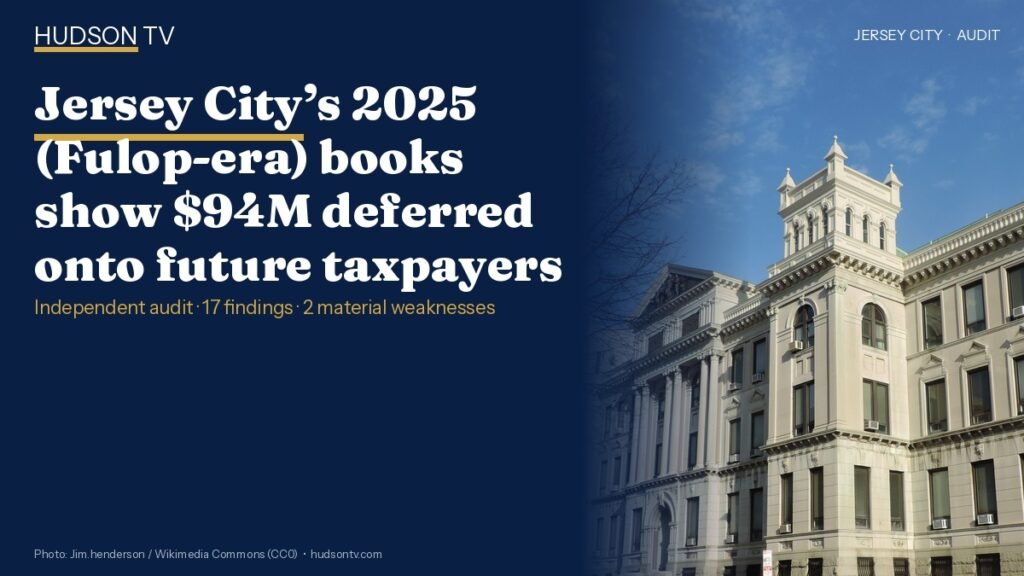
JERSEY CITY, N.J. — An independent audit of Jersey City’s calendar-year 2025 finances documents $94,124,946 in deferred charges that must be raised in future budgets, shifting costs onto taxpayers who did not receive the related services, according to a City of Jersey City press release dated Aug. 14, 2026.
The audit, prepared by certified public accounting firm Donohue, Gironda, Doria & Tomkins, LLC, covers calendar year 2025 — the final year of the previous administration — and does not cover any portion of 2026 under Mayor James Solomon. The city posted the report at JCNJ.org/audit.
Steven Fulop served as Jersey City mayor from about 2013 through 2025. The city’s release frames 2025 as the last Fulop-era budget year on the books. The audit does not accuse anyone of theft; it examines budget practices, internal controls, and accounting policies.
CY 2025 audit — key figures
Source: City of Jersey City press release, Aug. 14, 2026 · Donohue, Gironda, Doria & Tomkins, LLC
What “deferred charges” means here. The city’s release says the $94,124,946 figure represents costs incurred in prior years that were not paid when they arose and must instead be raised in future budgets. Writing about emergency appropriations, the auditors state that financing current operating costs in future budgets “shifts the financial burden to future taxpayers who did not receive the related services or benefits.” They note that emergency appropriations under the Local Budget Law are intended for “unforeseen expenditures requiring immediate action,” and that employee health insurance costs — the largest use of that mechanism in 2025 — are “recurring and reasonably estimable.”
Auditors issued seventeen findings and identified two material weaknesses in internal control. They also flagged the absence of a fixed-asset inventory (properties, buildings, equipment) that has not been maintained as State regulation requires since at least 2014 — a finding the release says has recurred in every audit since then.
Practices documented in the city release (figures as stated by the city):
- Health insurance budgeted below cost. The 2025 budget appropriated $147,385,033 for employee and retiree health insurance. In November 2025, about six weeks before year-end, the City Council adopted a $22,500,000 emergency appropriation, financed by notes, to cover health insurance and tax appeal costs the budget had not funded. Auditors separately identified $2,504,539 in October and November 2025 health insurance costs — including medical, prescription and stop-loss charges — that were not recorded as year-end obligations. In 2024, the city overspent its health insurance and related appropriations by $11,701,836.
- One-time revenue used as operating revenue. The audit records $33,136,809 in proceeds from the sale of municipal properties and $27,929,353 in cash reserves as 2025 operating revenue.
- Borrowing for operating expenses. The city entered 2026 with $78,663,122 in emergency and special emergency notes outstanding, including $33,200,000 for contractual severance obligations and $22,963,122 remaining from the 2021 operating deficit. That deficit totaled $92,939,388 and is being repaid in annual installments of $11,481,562 through 2027.
- Operating costs charged to capital. Auditors found microtransit service costs charged to capital improvement authorizations over multiple years without established statutory authority, and warned those expenditures “may be subject to reclassification and reimbursement to the capital fund” if determined ineligible.
- Older obligations left unaddressed. The report identifies $13,041,080 in completed capital projects — some dating to the 1970s and 1980s — for which funding was never provided and which can no longer be financed through bonds. It also confirms a $3.1 million payroll tax overpayment originating in 2019 is now uncollectible and must be funded through the budget — an issue the release says appeared in multiple prior reports and was not addressed until this year.
Records the city could not produce, per the release: overtime sampling found weak documentation (in a sample of 20 overtime payments, one covered ten hours against records supporting six; seven of twenty samples included no description of the work). A review of 25 severance payments identified a $32,240 overpayment from a manual data-entry error that was not caught before processing. The fixed-asset gap remains the recurring structural finding back to at least 2014; the city said it was advancing an RFP for a third-party vendor to build the inventory.
Next steps. State rules require a corrective action plan addressing each finding, approved by City Council resolution, within 60 days of receiving the audit. The Solomon administration said it completed that plan, assigning every finding to a named city official with a completion date; three findings were already resolved at the time of the release. Finance Director Bill Viqueira, quoted in the city’s release: “Jersey City taxpayers deserve a government that responsibly manages its finances, pays its bills on time, and is able to account for its assets. The findings identified in the 2025 audit point towards long-overdue actions that this city will immediately act on, and we are committed to meaningful improvement throughout the city’s fiscal management.”
Independent financial experts cited in the city’s release supported a serious reading of the document. Marc Shaw, senior advisor at the CUNY Institute for State and Local Governance, commended the city for a frank assessment. Marc Pfeiffer, associate director of Rutgers’ Center for Urban Policy Research, called the audit “a serious document” that “deserves a serious response” from the administration and the full governing body — not a plan that “sits on a shelf.”
Photo credit (featured): Jim.henderson / Wikimedia Commons (CC0), Jersey City City Hall. Primary source: City of Jersey City press release, “Independent Audit of Jersey City’s 2025 Finances Identifies 17 Material Weaknesses & Findings,” Aug. 14, 2026 (PR_2025_Audit_Release.pdf); full audit at JCNJ.org/audit. Framing note: CY 2025 is the final Fulop-era budget year; the audit does not cover 2026 (Solomon) and does not allege theft.
1 comment
Sign in to comment[…] office before Mayor James Solomon’s team took City Hall in January — the same prior-era books Hudson TV previously reported from the city’s own August audit release showing $94,124,946 in deferred charges on the 2025 […]