 Sunday, October 18, 2026 · Serving all of Hudson County since March 2011
Starbucks closing 250 stores — are boycotts a factor? Ed Sheeran and other campaigns compared
SEATTLE / HUDSON COUNTY — Starbucks said Thursday it will close about 250 underperforming coffeehouses in North America — roughly 1% of its more than 18,000 regional locations — and…
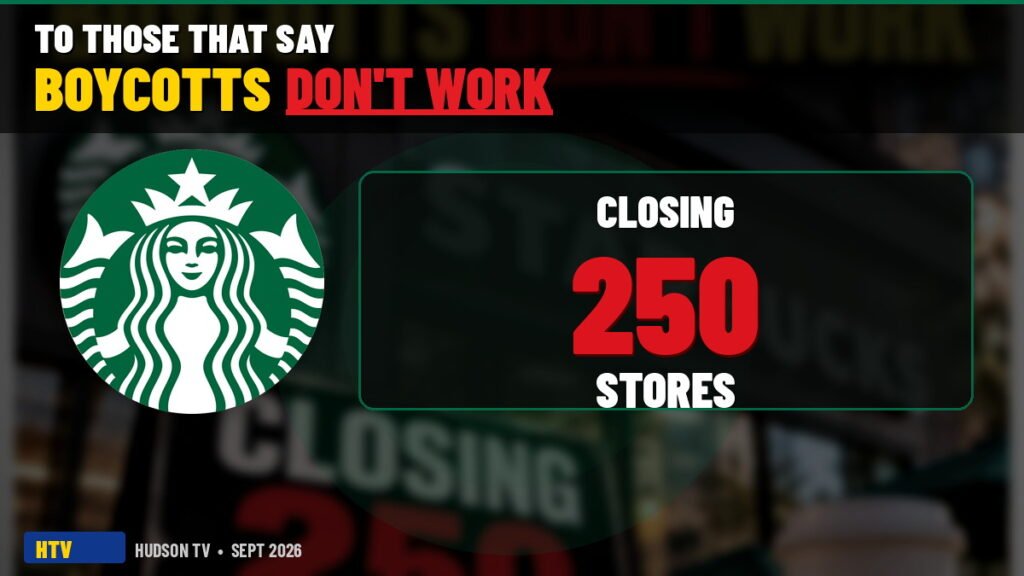
SEATTLE / HUDSON COUNTY — Starbucks said Thursday it will close about 250 underperforming coffeehouses in North America — roughly 1% of its more than 18,000 regional locations — and take about $300 million in restructuring charges as CEO Brian Niccol presses his “Back to Starbucks” turnaround.
That is the company’s story, backed by a Sept. 22 board action disclosed in a regulatory filing and amplified in a letter from Chief Operating Officer Mike Grams. Boycott promoters tell a different one: that sustained consumer pressure over Israel and Gaza, widely pushed since late 2023, is finally showing up in closed doors. Hudson TV is not treating either claim as settled fact. The question for readers — in Hudson County and beyond — is whether corporate framing tells the whole story.
What Starbucks documented
Upload video or photos
According to Reuters, CNBC, and Starbucks’ filing, the chain will shutter about 250 North America cafes that, in Grams’ words to employees, are places “where we do not believe we can consistently deliver the experience we want for customers and partners or where we don’t see a path to acceptable financial performance.” Most closures are expected by the end of fiscal 2026. About $200 million of the charge is cash (lease exits and separation benefits); about $100 million is non-cash asset impairment, CNBC reported.
The company also cut its fiscal 2026 outlook for net new global openings to about 440 from a prior 600–650 range, citing the North America closures partly offset by stronger international openings. Niccol’s team frames the move as portfolio cleanup inside a turnaround that has already included an earlier, larger wave of closures. Grams has said the North America business “has returned to strong growth,” per Seattle Times reporting — language that presents closures as pruning, not crisis.
The boycott question Starbucks did not answer
Nowhere in the filing or Grams’ attributed remarks does Starbucks credit — or even address — boycotts. That silence is the news peg for critics. Since October 2023, calls to boycott Starbucks spread widely online after Workers United posts expressing solidarity with Palestine were mistakenly tied to the company. Starbucks condemned those statements, sued over use of its name and logo, and has repeatedly said it does not fund any government or military operation — including Israel’s. “Starbucks has never funded military operations with any government, anywhere in the world,” the company stated in its public “For the Record” materials.
Activists and social posts still treat the brand as a pressure target. A widely shared X post this week cast the 250 closures as proof that “boycotts don’t work” is wrong. That post is opinion, not evidence. What is documented: boycotts were promoted for years; Starbucks denies the political funding claims that fueled them; the company now attributes closures to experience and financial underperformance. Whether boycott pressure is a hidden factor in “underperformance” is a question markets and filings have not answered out loud.
Ed Sheeran: a celebrity boycott, different tools
Put Starbucks beside the September 2026 fight around Ed Sheeran’s U.S. Loop tour. After Macklemore said “Free Palestine” onstage at MetLife Stadium in New Jersey, venues and the tour promoter moved to drop him from remaining dates; Sheeran said the promoter’s decision was final and that he tried to broker a compromise, including talks involving Gillette Stadium owner Robert Kraft. Supporting acts including Finneas, Aaron Rowe, Beoga, and Lukas Graham then withdrew in solidarity, Guardian and Al Jazeera reported. The Palestinian Campaign for the Academic and Cultural Boycott of Israel (PACBI) called on audiences to boycott the “compromised” tour.
What readers can verify: artists left the bill; BDS-aligned organizers urged a boycott; Sheeran continued the tour framing. What was not a boycott win: Sheeran’s Gillette Stadium concerts were canceled days later because of severe weather warnings, the promoter said — not because ticket-buyers emptied the building. Unlike Starbucks’ SEC filing, there is no corporate 8-K declaring “boycott losses.” The contrast is the point: a global chain’s portfolio cut vs. a tour-politics storm. Activists claimed leverage in both; only Starbucks put hard closure numbers in a filing — and attributed them to something else.
Other same-reason boycotts since Oct. 2023
Starbucks is not alone. Several high-profile brands faced BDS-style or Gaza-war consumer campaigns. Claims and company lines differ:
McDonald’s — Activists boycotted after the Israel franchisee advertised free meals for Israeli soldiers. McDonald’s Corporation said those actions were independent, that it was “not funding or supporting any governments involved in this conflict,” and later agreed to buy the 225 Israel restaurants from the franchisee (Reuters, AP, CNBC, 2024). The company and franchisees in Muslim-majority markets publicly distanced themselves; sales pressure in the region was widely reported as a driver of the buyback.
Carrefour — The BDS movement targeted the French retailer over its Israel franchise partnership. Carrefour denied material military support by its Israeli franchisee, called some circulating claims “fake news,” and later stressed “strict political neutrality.” In November 2024 its Jordan stores closed amid an intense local boycott campaign; Carrefour announced the exit without spelling out boycott as the formal cause (The New Arab / Business & Human Rights Centre).
Disney / Marvel — PACBI and allied groups urged boycotts of projects casting Israeli actors Gal Gadot and Shira Haas, accusing the studios of cultural “whitewashing.” Separately, activists cited Disney’s post–Oct. 7 humanitarian donation to Israel. These are campaign demands and casting controversies — not a SEC-style store-closure disclosure.
HP / HPE — A long-running BDS priority target over alleged technology ties to Israeli military and occupation systems. Campaign literature and research groups (including Who Profits) focus heavily on Hewlett Packard Enterprise after the 2015 corporate split; HP Inc. has disputed some circulating claims and said it does not take political sides. Treat brand-level “HP” claims carefully: the corporate family is not one filing.
What Hudson County readers can take away
Consumer politics travel. Jersey City, Hoboken, and Bayonne coffee counters sit at the same brand as Seattle’s filing. The documented record shows: Starbucks is closing ~250 North America stores and booking ~$300 million in charges under a turnaround narrative; boycotts over Gaza have been loud and global for nearly three years; Starbucks denies funding Israeli government or military operations; other brands — McDonald’s, Carrefour, Disney, HP — faced parallel campaigns with mixed, often contested outcomes; Ed Sheeran’s tour fight shows how Israel/Gaza politics can scramble entertainment logistics without producing a clean “boycott caused X” ledger line.
Did boycotts help push Starbucks to lock the doors on 250 cafes? The company says no — it says those cafes underperformed on experience and finance. Activists say look at the pressure. Hudson TV’s job is not to pick a team. It is to put the filing, the Grams letter, the company denials, and the boycott campaigns on the same page — and ask whether “Back to Starbucks” is the full truth.
Sources: Starbucks 8-K / company statements; Reuters; CNBC; Seattle Times; Starbucks “For the Record”; NBC News; Guardian; Al Jazeera; PACBI/BDS; AP; The New Arab; Business & Human Rights Centre. Boycott causation for the 250 closures is not established as fact in company filings.